
Location-based mobile marketing: how to bring customers back into your store
How do you get people into physical stores today? This question concerns marketing professionals in brick-and-mortar retail more than ever. Much of the customer journey now happens online, attention is fragmented, and traditional advertising measures are measurably losing impact.

At the same time, studies from Austria show that younger target groups, particularly Generation Z, still enjoy shopping in physical stores — provided the store is relevant to them, digitally integrated, and present at the right moment. (1)

In most cases, success depends on the interaction of three factors: attention, reason, and trust. Only when all three come together does real foot traffic occur.

Attention almost always starts online today

For many customers, the journey to a physical store begins online. In most cases, the first step in a purchasing process is a quick search on social media or Google. People look at photos, read reviews, and decide within seconds whether a visit is worth it.

That’s why a strong social media presence and a well-maintained Google listing — including up-to-date opening hours, appealing visuals, and authentic customer reviews — are essential. If a business fails to convince at this stage, it is unlikely to be noticed offline.

At the same time, AI-generated answers are becoming increasingly important, as more and more people direct their questions to LLM systems such as ChatGPT. To appear in these contexts, retailers need consistent, structured, and publicly accessible information on their websites — especially clearly described services and regularly updated content.

After this initial online research, the journey continues: into the store itself. Which brings us to the next step — creating a clear reason to walk in.

Customers need a clear reason to walk in

Hardly anyone enters a store purely by chance. Promotions, small events, limited-time offers, or exclusive products, services, or samples available only on-site provide a concrete reason to step inside. In many cases, memorable experiences are more effective than simple discounts, because they spark curiosity and stay with customers.
Foot traffic can also be generated beyond the store itself — through partnerships with other local businesses, visibility at community events, or special initiatives for loyal customers. This is how occasional passers-by can turn into regular visitors over time.

Trust and relationships make the difference in-store

Online purchases may be faster or cheaper. However, personal advice, atmosphere, and the feeling of being welcome can only truly be experienced in a physical store. Customers value friendly interactions, honest recommendations, and small extras — simply because people appreciate feeling comfortable and acknowledged.
Retailers who present themselves as approachable and authentic, who tell stories and show personality, build long-term trust. Social media can further support this effort — for example, through a well-managed and consistently updated Instagram presence. Behind-the-scenes insights reduce perceived barriers and create a sense of closeness.

A situational trigger through location-based mobile communication

This trust-building concept for the physical store can be effectively complemented by location-based mobile marketing — delivering relevant, situational impulses when attention and intent are already present.
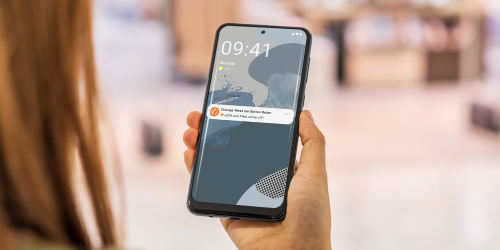
For example: A customer walks past a store in the city center and receives a smartphone push notification highlighting a promotion that is valid in-store today only.
Studies show that location-based offers are perceived as more relevant and measurably increase the willingness to visit. More than 55% of consumers consider such messages more helpful than traditional advertising. Around 80% say they are more likely to enter a store when they receive a relevant notification. (2) Smartphone push notifications — as in the example above — play a key role in this context. They achieve open rates of over 40% and reach users directly in their daily lives, without algorithmic filtering. (3)

A practical example: mobile-pocket as an opt-in channel

The mobile-pocket platform illustrates how mobile communication can work effectively in retail: content is delivered exclusively to users who have registered their loyalty card in the app and actively opted in to receive messages. This ensures that communication is targeted at customers with an existing connection to the brand, minimizing wasted reach and significantly increasing relevance.
At the same time, mobile-pocket enables a personal but non-intrusive form of contact. Smartphone push notifications do not replace the conversation in-store — they extend it. A short message about a promotion, a reminder of a bonus, or an invitation to an event can create a new reason for the next visit, exactly when it makes sense.

Conclusion: think digital, act physical

Increased foot traffic in brick-and-mortar retail does not result from a single marketing tactic, but from the interaction of attention, reason, and trust. It also requires a brand that clearly represents what customers identify with — whether that is quality, regional products, or a style that reflects their self-image.
Location-based impulses can strengthen this system when they are context-driven, opt-in-based, and thoughtfully integrated. Because creating proximity is not only about knowing where potential customers are — it is about understanding why they come, and why they choose to return
Sources:
(1) www.wko.at/wien/handel
(2) wifitalents.com/geofencing-statistics
(3) sqmagazine.co.uk/mobile-marketing-statistics
Learn more about the benefits of mobile-pocket for your retail business:
Feel free to reach out if you would like to discuss your challenges in attracting and retaining customers, or to arrange a brief demo.
Sales Manager Magdalena Schneidhofer
Head of Platform Sales - mobile-pocket
Magdalena Schneidhofer

Ready to increase your customer value?

Contact form blog posts Christina

News & Blog

A smartphone held by a woman, showing a mobile-pocket ad push notification on the lock screen.

Ad push notifications: Why smartphone lock-screen pushes are the new premium ad space for brands

How do brands stay visible today? With targeted smartphone push notifications — and here’s why they work so well.
A young blonde woman wearing a hat and a leather jacket stands in a city holding a smartphone in her hand. A blurred building can be seen in the background, and the mobile-pocket logo is located in the bottom right corner.

Geofence marketing: reaching customers where purchase decisions are made

Reach customers via smartphone push notifications exactly where purchase decisions are made – local, relevant, and measurable.
Subscribe to our newsletter
Stay ahead of the competition with our newsletter on digital customer loyalty.
Newsletter subscription
Which industry or industries would you like to receive our newsletter for? *